
Search Marion County Property Records
Three official systems carry the core search. Revenue Commissioner CAMA and GIS data links an address or owner to a tax parcel. The Judge of Probate's ING land index supplies recorded deeds, mortgages, liens, releases, and plats. The county tax system adds payment and delinquency detail. Keep the parcel number, legal description, owner, and deed book/page/date aligned across all three. Start with the most stable clue. A full parcel key beats everything else. Addresses are convenient but may use a road abbreviation or lack a street number. Owner names can bring in joint parties, estates, trusts, companies, or public bodies. Official property records support due diligence. Still, CAMA is not a title opinion, and GIS is not a survey.
- Run the Marion County property lookup by address, owner, PIN, or parcel.
- Open the card and copy its physical address, parcel key, legal text, and deed reference.
- Search the Probate index for the newest matching deed and any linked releases.
- Review tax status and map context under the same account and land description.
- Use the courthouse counter, mail, phone, library, or archives when the online trail stops.
Every source plays a separate legal role. The parcel card works as the practical index. A recorded instrument is transfer evidence, the tax record shows assessment and payment, and the map supplies location context.
Marion County Records Custodians
Hamilton serves as the county seat. The courthouse at 132 Military Street South holds the main land, tax, and court access points. It offers the central land, tax, and court access. Hours run Monday through Friday, 8:00 a.m. to 4:30 p.m., with a noon-to-1:00 p.m. closing. Ask one office for one record. A specific request beats asking for everything tied to a name.
Revenue Commissioner
132 Military Street South
Hamilton, AL 35570
205-921-4996 appraisal
Marion CAMA Starts the Search
The basic CAMA search accepts a PIN, parcel number, owner, physical address, acreage, total value, district, or subdivision. Expanded tabs add mailing address, deed book/page/date, plat reference, section-township-range, land use, building year and area, and improvement fields. Rows can be mapped, printed, or routed to parcel, building, land, and improvement detail. The detail card is dense. It lists owner name, mailing and physical addresses, parcel, PIN, account, subdivision, neighborhood, district, city, acreage, deed B/P/D, a brief description, land and building totals, appraised value, tax history, and building features. Those fields make CAMA a strong index. Remember what it is not. The county cautions that data changes and carries no guarantee of accuracy, timeliness, sequence, or completeness. Treat it as an assessment record. The Marion Public GIS portal anchors the visual side.
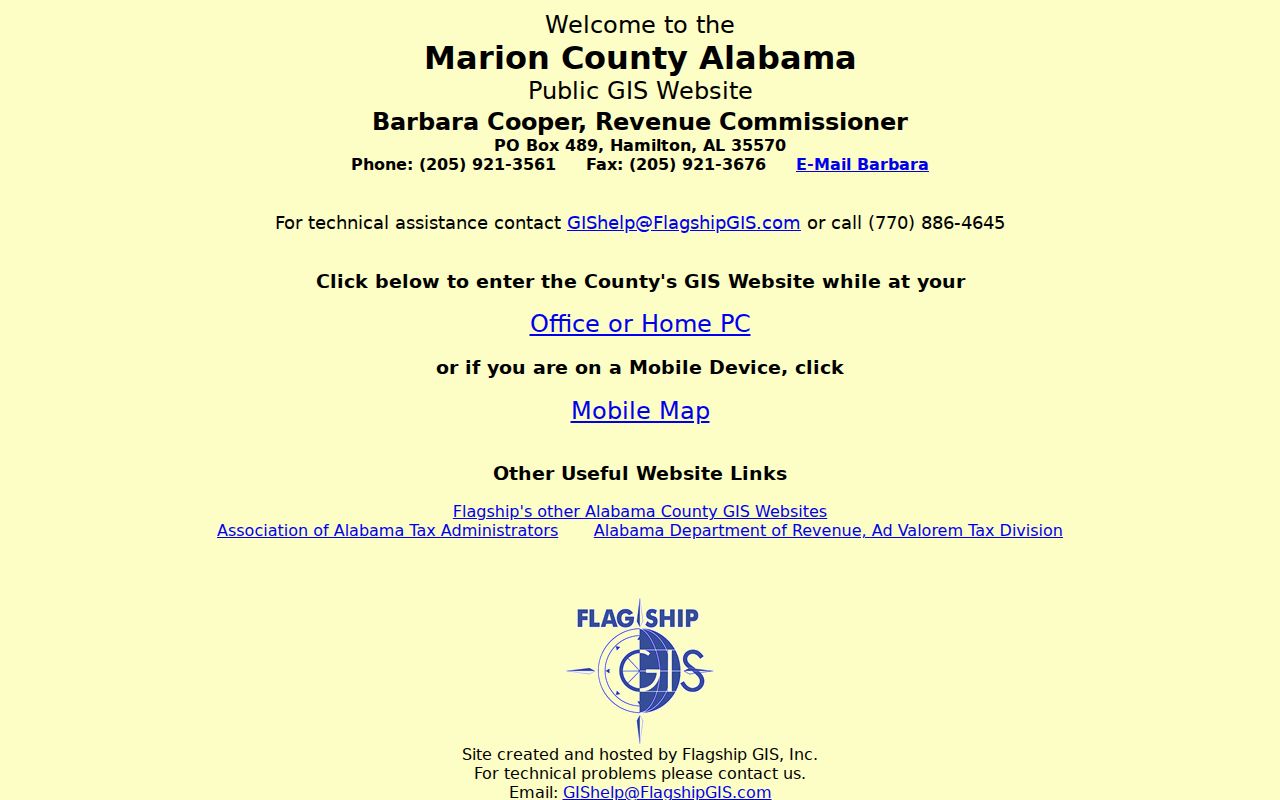
The portal links parcel searching to map access. The underlying card remains an assessment record rather than surveyed or titled proof.
Marion Addresses Have Two Roles
Physical and mailing addresses serve different jobs. One rural parcel sits at 1074 County Highway 135 in the GUIN neighborhood, while its tax mail goes to a Winfield post office box. A Winfield parcel at 137 Mill Street carries a Hamilton mailing address. Neither mismatch moves the land's situs. Compare the CAMA City, Neighborhood, Tax District, physical address, and mailing address before drawing conclusions. ZIP codes are delivery geography. They do not prove municipal limits or occupancy. Hamilton, Winfield, and Guin mailing names can serve rural property outside those city lines, so the full legal description is the safer bridge to the deed index.
Marion County Record Sets
No single file is the complete property record. Match the record set to the question, then cross-check with the same parcel and legal description.
| Record Type | What It Documents | Kept By | Access |
|---|---|---|---|
| Deeds and releases | Transfers and recorded claims | Judge of Probate | ING account or courthouse |
| Assessment card | Owner line, values, buildings, tax history | Revenue Commissioner | Free CAMA/GIS |
| Tax payment and liens | Payment and delinquency status | Property Tax Office | County and state systems |
| Parcel and plat clues | Location, lot/block, S/T/R | GIS and Probate | Viewer, index, courthouse |
| Permits and zoning | Regulatory file and approved work | Relevant city | City request and posted forms |
For the recorded transfer chain, use Marion County deed records. Tax records explain assessment and payment. GIS and plats frame location, court files add foreclosure, quiet-title, partition, and judgment material, and municipal files cover permits and zoning rather than county title.
Marion Probate Search Controls
The ING land index supports party roles, date and book/page searching, instrument selections, filtering, sorting, and image ordering. Grantor conveys an interest; grantee receives it. Assignee applies when a right or claim is assigned. Search every useful role. The same name can appear differently across deeds, mortgages, and releases. The public instructions hide useful details. A checked “Starts With” limits the name to its beginning, while unchecked searches for the text anywhere. CTRL selects more than one instrument type. Condensed results may show only the first party, so use Show All Index before excluding a transfer; book/page links open a document or its page selector. The Marion Probate access screen is the official entry to land-record searching.
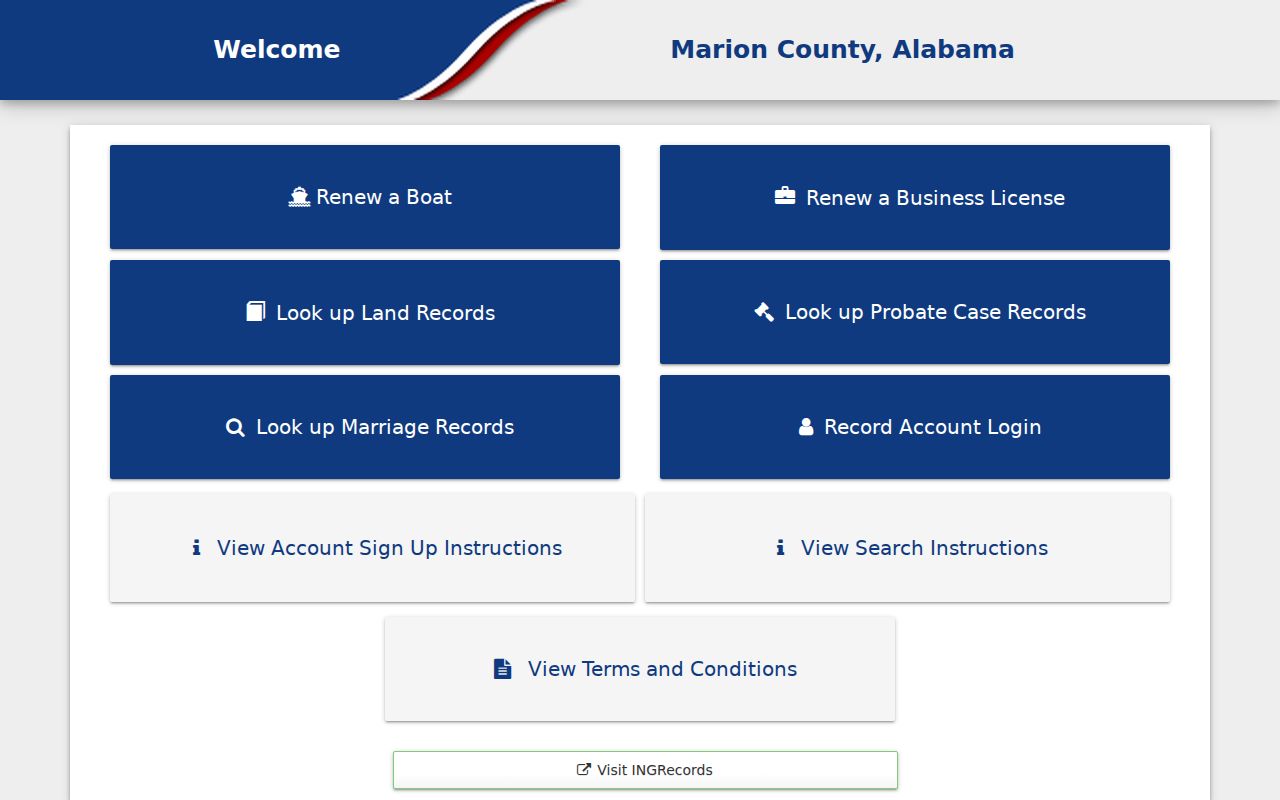
The access screen ties the deed lookup to the county's broader Probate record environment. Each record type keeps its own search route. Deeds are the main draw. Note: A free account or pay-per-document route is required for access, and the exact image fee appears in the live workflow.
2007 Did Not Start All Deeds
Marion County says digital scanning began in 2007. That date is narrower than it sounds. It does not fix the first year of an online deed index, promise that every later page is imaged, or mean all earlier deeds stay offline. A missing result is not proof. The careful move is a courthouse search. Give Probate staff the names, an approximate year, a book and page if known, the parcel number, and the full legal description. The county publishes no exact historic deed-book or microfilm ranges. The Alabama Department of Archives and History, local historical societies, and libraries can add context. The Probate Office still keeps the land records.
Marion Parcel Descriptions Vary
Town parcels usually run by lot, block, and subdivision in Marion County. Sample cards name Vestavia Hills, Ray Thompson Estates, Alabama Mills, and the Clarence J. White plat. Rural tracts read differently. They lean on quarter sections, compass calls, rights-of-way, and section-township-range descriptions. The visible parcel number carries the county prefix plus map components, but Marion County publishes no decoding legend.
A legal description can outlive a street name. Copy every call in full. Search both the subdivision field and the brief-description text, since a plat name may appear in only one. Expanded GIS search adds plat book and page fields. The county offers no complete downloadable plat inventory.
The sample cards show why both fields matter. One Winfield card puts Lot 8, Block 3 in Alabama Mills and also cites the Clarence J. White plat. A Hamilton record places Lot 39 and part of Lot 40 in Vestavia Hills. Another Hamilton card names Ray Thompson Estates only in its brief description, leaving the subdivision field blank. A dropdown-only search misses that parcel. A road-only search can miss a rural tract whose deed runs by section, township, range, and compass calls.
Pin, account, and parcel number are separate keys. The portal may show a spaced parcel in one view and a condensed number in another. Preserve each value exactly as displayed, along with its owner and legal text. That habit helps Revenue Commissioner or Probate staff match the same land when a web query fails. Never guess at component meanings. Marion County has published none.
Marion Taxes Add Current Context
Marion's assessment cards show a 2025 label over 2024 tax-history rows. That is normal data labeling. It is not a sale history. The public card separates land, building, and appraised totals. Alabama applies assessment classes to appraised value, then millage and exemptions shape the tax due. The county property-tax route takes a tax year, search type, terms, and subdivision, though results vary. ALPropTax and a payment office also serve payers. For delinquency, a 2025 tax-year auction notice named a May 2026 sale and a $45 administrative fee, yet the published list carries no parcel rows.
Property Cases Use the Circuit Clerk
Foreclosure, quiet title, partition, redemption, and judgment disputes land in circuit or district court records. The Marion Circuit Clerk access page lists an office terminal, written requests, and the remote Just One Look docket service. Many pleadings still need a clerk copy request. Copies cost $5 for the first 20 pages. Each added page is $0.50. Certification adds $5. Mailed requests call for a money order rather than a personal check, and older or large files may take up to 30 days. Search the case by party and term. Then match the case number and any resulting deed or release back to the Marion County Probate Office.
Note: Court dockets can explain a transfer or lien, but they do not replace the recorded land instrument.
Hamilton Was Not Always the Seat
Marion's own official history traces a shifting record geography. Cotton Gin Port held the seat in 1818. Pikeville had an early surveyed courthouse site. Military Ford and Toll Gate came before the Hamilton era, and the Hamilton courthouse itself dates to the 1880s. An old place name in a deed or plat is a research clue, not an error. The state archives Marion finding aid lists communities, Guin, Hamilton, Winfield, Pikeville, landmarks, people, and correspondence. The county historical society preserves documents and photographs. Use those collections to decode a place or road, then return to the land books for proof.
City Files Complete Marion Research
County records fix parcels, assessments, and recorded interests. City records answer other questions. Hamilton publishes zoning and ordinance material. It offers no address-keyed permit database. Winfield's Planning Commission supplies zoning, sign, complaint, map, and building-application resources, while Guin routes local records, business-license, cemetery, and council questions through its City Clerk. Postal areas can reach past city lines. So contact the right city with the parcel's physical address, legal description, and tax district instead of trusting a mailing city or ZIP.
Limits of Marion Property Records
Marion County property records can answer a lot of practical questions. The tax roll shows the owner of record, the mailing address, and the parcel number. Assessment figures and tax history sit alongside the deed reference and any recorded encumbrance. A tax map or GIS map can even show where the lot sits. What records cannot do is settle the hard questions. They cannot turn a GIS line into a surveyed boundary. They cannot guarantee the roll already reflects a just-recorded deed. They also cannot expose every unrecorded interest. For a market value opinion, you still need a professional appraisal.
Alabama's Public Records Act, Code §36-12-40, gives citizens the right to inspect and copy public records. That right is subject to statutory exceptions. No single statewide request form, deadline, or fee applies across agencies. A request should name the record, the date range, the parties, and an identifying reference. Protected court, voter, adoption, and tax-return data stays outside ordinary access.
Lawful use. Marion County property records support purchase diligence, estate work, boundary research, tax questions, and civic transparency. They may not be used to harass or harm anyone.
Some conclusions need more than a file search. A binding title or boundary answer calls for the proper professional and a certified source. Confirm a current transfer with the newest deed. Confirm a line with a licensed survey. Bring in a qualified appraisal for a market opinion.
Timing matters too. Marion County publishes no standard lag between a closing and the assessment-roll update. When the tax owner conflicts with a newer deed, record both dates and treat the latest matching recorded transfer as the stronger evidence. Mailing addresses change for reasons that have nothing to do with ownership, and paying the tax bill does not prove who holds title.
Estate and trust ownership poses its own trap. A parcel can list an estate, joint owners, a company, a trust-like name, an administrator, or a government district. A simple name match will not sort that out. Search the precise indexed party and the related Probate case, then inspect the instrument itself. Never infer an unseen beneficial owner from a mailing address or from personal details found elsewhere.
Historic sources have a different limit. Newspapers, Sanborn maps, archive folders, and local-history collections can reveal buildings, streets, owners, and events from an earlier era. They enrich a house history. They do not establish a present parcel line or title. Tie the historic clue to a named plat, a legal description, or a deed before claiming a modern tract.
Tax-sale records deserve the same caution. A list entry is not proof of foreclosure or ownership. State guidance distinguishes a tax certificate from a tax deed and warns that neither necessarily delivers clear title. Check payment or redemption status, the county transcript, any court case, and the later recorded instrument before relying on the sale history.
A good Marion County record file keeps sources separate while preserving their links. Save the parcel card, the full deed citation, the map view, the tax date, and any court case number. Note the day each source was checked. Public data changes, and an orderly record of those checks makes later verification far easier.