
Marion County Deed Types
Land instruments in Marion County are recorded by the Judge of Probate. A deed may move an ownership interest, so its label and wording deserve close attention. Not everything in the index transfers title, however. Some records only place, assign, or release an encumbrance. That makes naming the instrument type and every party the right first move.
| Deed Type | What It Does | Common Use |
|---|---|---|
| Warranty deed | Conveys the stated interest with promises written in the instrument. | Ordinary sale or family transfer |
| Quitclaim deed | Conveys whatever interest the grantor has without broad warranties. | Interest or estate cleanup |
| Administrator or executor deed | Records a transfer made through estate authority. | Property transferred after death |
| Sheriff's or tax deed | Reflects a statutory or court-linked sale process. | Execution or delinquent-tax research |
| Mortgage, lien, or release | Creates or clears a claim rather than a simple ownership transfer. | Encumbrance history |
Assignments, satisfactions, judgments, and easements sit in the index too. A search should reach past the original lien. Recordation only proves an instrument entered the public records. It does not guarantee that every statement is true or settle an unrecorded claim.
Inside the Marion ING Index
The Marion Probate ING portal handles land-record, probate-case, and marriage lookups in one place. Land documents work through an account or a pay-per-document route. Searches run on names, dates, and book/page clues, with party and instrument controls narrowing the results.
| Index control | How it works | Research value |
|---|---|---|
| Party role | Grantor, grantee, assignee, or all | Separates conveying and receiving parties |
| Starts With | Checked matches the beginning; unchecked searches contains | Finds prefixes and varied index forms |
| Instrument Type | CTRL selects multiple types | Combines related deed and release queries |
| Filter / Sort | Refines and orders rows | Isolates likely transfers |
| Show All Index | Expands parties hidden in condensed view | Reveals co-owners and other names |
| Book/page link | Opens the image or page selector | Moves from index to instrument |
Multipage records ask you to pick pages before anything goes into the cart. Finished purchases land under My Documents. The portal publishes no complete instrument menu. It also sets no firm online cutoff and no fixed image charge outside the live order flow. The official Marion Probate portal carries the land-record entry point.
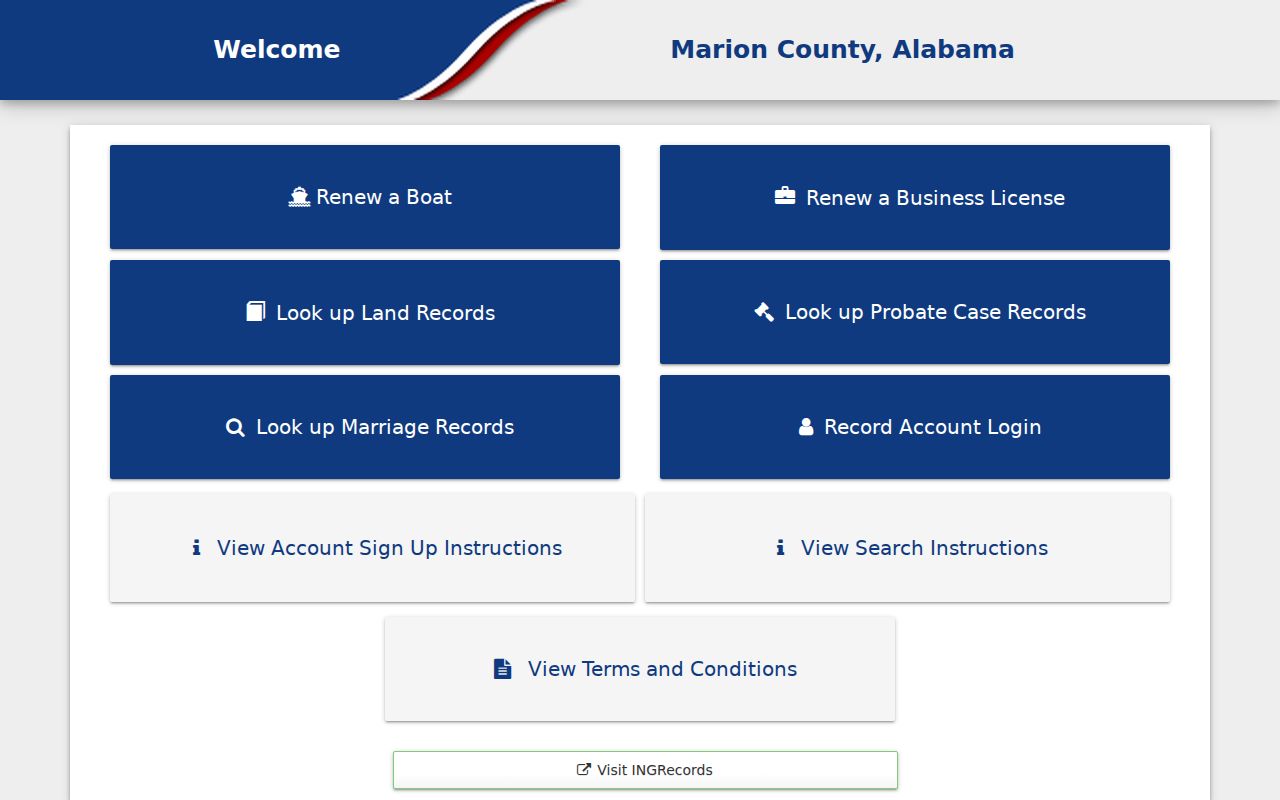
On the portal's main screen, the land-record entry point sits beside Probate case and marriage lookup options. Navigation is plain once you spot it. Note: Leave “Starts With” unchecked and expand all indexed parties before treating a short name result as complete.
Marion's 2007 Scanning Milestone
The county's Probate public-records page reports that computerized scanning began in 2007. Treat that as a workflow milestone rather than a coverage date. Nothing from the county or the public instructions says the index starts in 2007, that all later instruments are complete online, or that every earlier book exists only on paper. Search online first. When an expected transfer fails to appear, contact the Probate Office with the parties, the approximate year, a parcel number, any book/page clue, and the full legal description. Courthouse staff and physical books remain documented access channels. A missing web result is not a lost deed.
Coverage check. Marion County publishes no exact first online deed year. Confirm the needed book range with Probate before ending a chain.
Build a Marion Deed Chain
A grantor conveys an interest. A grantee receives it. Link those transfers for the same land and you have a chain of title. The current CAMA card is the practical starting point, since it often lists the tax owner along with the deed B/P/D, meaning book, page, and date, which gives the Probate index a focused opening.
- Copy the current owner, parcel key, deed B/P/D, and full legal description from CAMA.
- Search the current owner as grantee and open the newest deed matching the land.
- Record its grantor, dates, legal description, and any prior deed reference.
- Search that grantor as an earlier grantee, repeating while the land description matches.
- Use Probate cases, plats, court files, and courthouse books when an estate or other event interrupts the chain.
- Grantor
- The party conveying the stated interest.
- Grantee
- The party receiving that interest.
- Chain of title
- The linked record of transfers affecting the same land.
- Book and page
- The reference locating a recorded instrument.
CAMA Bridges Marion Deeds
The free Marion GIS/CAMA search is a solid opening move for a deed project. Detail cards expose the parcel, PIN, account, owner, physical and mailing addresses, subdivision, neighborhood, legal description, values, tax history, and deed B/P/D. Treat the reference as a bridge to Probate rather than the deed itself. Sampled cards show how it works. A rural card points to Book 2016, Page 4278. A Winfield Alabama Mills card carries a 2019 reference and Lot 8, Block 3. A Hamilton Vestavia Hills card lists a 2023 deed reference and the affected lots. Clues like these build a far better Probate query than an address alone ever could. Note: Sampled CAMA cards carry no verified sale consideration. So read the deed rather than treating appraised value as the sale price.
Liens Beside Marion Deeds
Ownership work should reach well past deeds. Mortgages, assignments, lien releases, judgments, easements, and satisfactions can all shape the record trail. Search debtor, lender, assignee, grantor, and grantee variants across useful dates. Match each release to its original reference before assuming a lien is clear. Tax delinquency lives in separate sources. Marion's current notice covers a 2025 tax-year lien auction and a $45 administrative fee. Yet its posted list carries no parcel rows. An empty display does not erase a past delinquency. Alabama's state-held process can end in a certificate or a deed. Neither guarantees clear title. Court enforcement may also require the Circuit Clerk terminal or written route.
Historic Names in Marion Deeds
Marion County's record geography predates Hamilton. County history puts the seat at Cotton Gin Port in 1818, later court activity near Columbus, a courthouse era in Pikeville, and a final move toward the Military Ford and Toll Gate area. Hamilton got its courthouse in 1883. Old instruments can therefore name places that match no modern mailing address. Follow section-township-range and quarter-section calls, roads, waterways, plat names, and older deed references before blaming an index error. The ADAH Marion finding aid lists communities, Pikeville, landmarks, correspondence, and local-history files that explain old geographic terms. Archives add context. The recorded land instrument remains the transfer evidence.
Estate Transfers in Marion Records
A clean chain of title does not always survive a death in the family. When an owner dies, Marion County Probate takes over the estate side: wills, administrations, conservatorships, guardianships, and condemnation matters. The land records still tell their half of the story. An administrator's deed or executor's deed moves real estate out of a probate case, and that instrument lands in the recorder's index like any other deed.
Search the index in several roles. Try the decedent, the estate, the personal representative, and each recipient. A will can name heirs without ever producing a deed in the ordinary buyer-seller sequence, so the probate-case route matters as much as the grantor-grantee books. Restricted portions of a judicial file may stay closed. The recorded deed, though, remains public.
Death certificates are a different animal. Alabama restricts them for 25 years, and later records can be ordered by anyone supplying enough identifying facts. A certificate helps pin down identity and dates. It conveys nothing. Whatever estate order or representative deed surfaces, match it back to the same legal description, because the parcel, not the person, is what the county index tracks.
Even a sealed file rarely hides the transfer itself. The probate order, the representative's deed, or a later deed among family members restores the public chain, and the book/page citation carries the parcel forward for the next searcher.
Note: Restricted probate file portions stay unavailable even when the resulting Marion County deed is public record.
Request Marion County Deeds
Online, the workflow is straightforward. Open a book/page result. Select the pages. Add them to a cart, and download from My Documents. The service supplies a receipt or link. A cart charge is a retrieval cost, not Alabama recordation tax. So keep the two separate.
A courthouse request goes faster with full details. Bring the grantor, the grantee, and the instrument type. Include an approximate date, the book/page if known, the parcel number, and the complete legal description. Say up front whether you need a certified copy. The Marion County Probate Office lists its contact as 205-921-2471 and marioncountyprobatejudge@gmail.com. For a general parcel lookup, the Marion County property search is the right tool. The deed records exist for the recorded transfer itself.
Recorded, not guaranteed. Filing gives public notice, but it does not prove the grantor owned every claimed interest or that title is clear.
Some problems outrun a records search. A gap in the chain, a conflicting legal description, an unreleased lien, an estate dispute, or a doubtful signature calls for an Alabama title attorney. The same problems can call for a title company. Deed records support diligence. They do not supply a title opinion.
Taxes and copy fees are separate creatures. State sources put Alabama deed tax at $0.50 per $500 of value. Mortgage tax sits at $0.15 per $100 of debt. Those figures govern recording, not retrieval. Ask before sending payment. Have Probate distinguish a plain copy, a certified copy, a portal image, and a recording fee.
Older instruments reward patience. Note every citation a later deed makes to an earlier one. Prior book/page clauses often walk you through an era that a name search handles poorly. A plat name, a lot and block, or a section-township-range description helps too. It can separate two deeds involving the same surname. Keep spellings as indexed. Then try sensible variants instead of rewriting the historic name.
Litigation creates its own paper trail. A Marion County land instrument may grow out of quiet-title, foreclosure, partition, redemption, or judgment litigation. The Circuit Clerk is then the fallback office. The terminal there can expose a docket that is clumsy to reach remotely. Written copies of old or large files can take up to 30 days. Match the case disposition to the later Probate filing rather than assuming the docket alone changed title.
Watch for seller-impersonation fraud. The statewide Property Protection Act takes effect October 1, 2026. Marion County publishes no property-fraud alert signup, so do not count on one. Owners worried about a suspicious filing should monitor current Probate entries. They should keep their deed references close. They should also contact the custodian or qualified counsel.
Note: Enrollment claims for an alert service the county does not publish should be treated with suspicion.