
Trace Marion County Former Owners Transfer by Transfer
A backward chain begins with the deed reference on the current Marion CAMA card. From there, the same land is followed through earlier grantees and grantors. It moves one transfer at a time. Treat the table as a worksheet. It makes no claim about any real property's history. Fill in each row only after the Marion Probate land index or an office record supplies the parties, the date, and the instrument type. The record must also supply the citation. That discipline keeps the deed records honest as the chain grows.
| Transfer Date | Grantor → Grantee | Deed Type | Book / Page |
|---|---|---|---|
| Newest verified deed | Most recent grantor → current grantee | As indexed | Record exactly |
| Prior verified deed | Earlier grantor → newest deed's grantor | As indexed | Record exactly |
| Next earlier link | Prior grantor → prior grantee | As indexed | Record exactly |
Moving backward, the seller in one deed becomes the buyer you hunt for next. That grantor-to-grantee reversal is the core technique of any parcel search. It is simple until it is not. An estate, court order, merger, trust, or name change can break the pattern, so keep the legal description attached to every row of the chain.
Reverse Marion County Prior-Owner Names With Role Filters
ING's public instructions outline name, date-range, and book/page searches. Party roles include Grantor, Grantee, Assignee, or all. Set a tight date window around the last known transfer first. Then widen it if the deed records do not surface. The Starts With control matters too. Left unchecked, it runs a contains search. That can catch a surname buried inside a longer estate or entity entry.
| Control | Use in the chain | Caution |
|---|---|---|
| Grantor | Find transfers out by a prior owner | Match the land, not just the name |
| Grantee | Find how that owner acquired it | Try initials and punctuation variants |
| Date range | Narrow a likely ownership interval | Do not infer dates from a tax year |
| Book / page | Jump to a known reference | Read all pages of the instrument |
| Starts With | Choose prefix or contains matching | Broad results include unrelated parties |
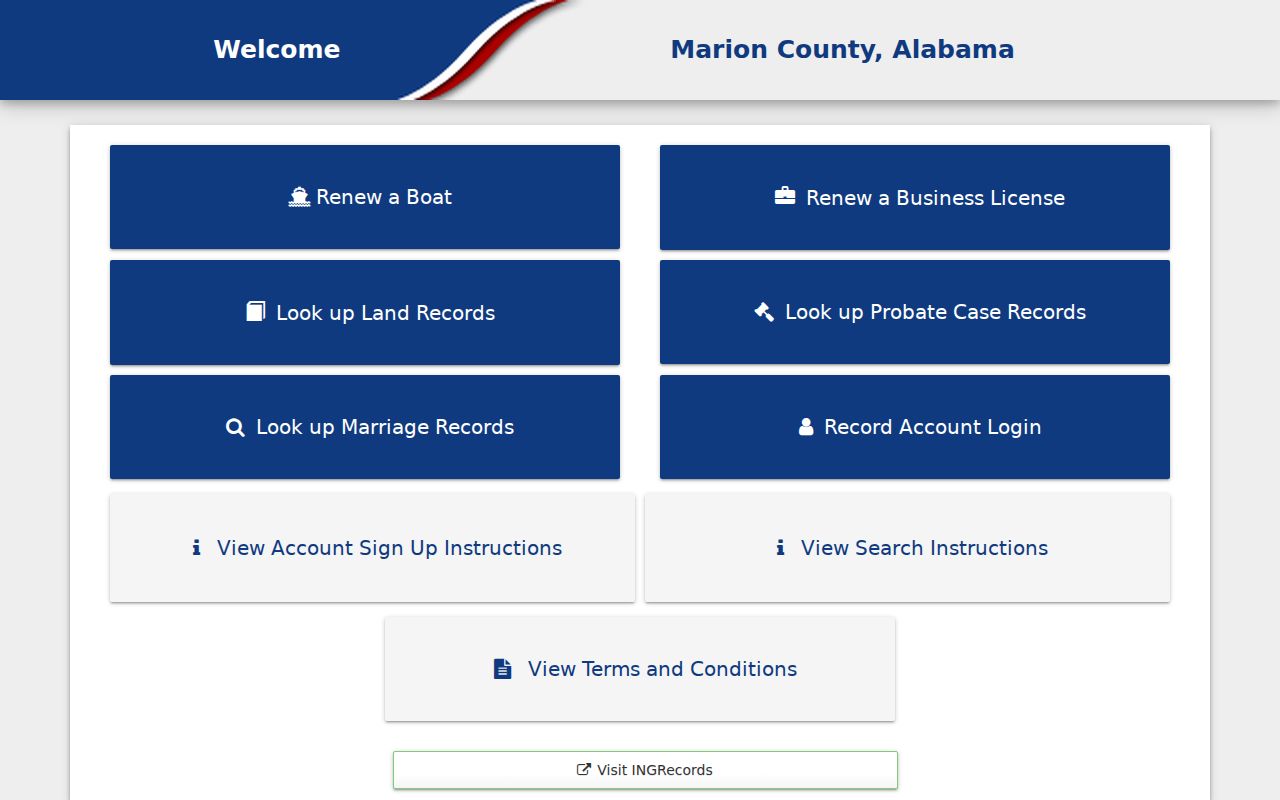
Results can be filtered, sorted, and expanded with Show All Index. Book and page links open the documents themselves. Multipage files use Select Page(s) and Add Doc to Cart. The Marion Probate portal landing page shows the entry point for this land-record route.
Document access requires an account or a pay-per-document route. When the web path hides a former-owner record, courthouse staff can help locate it in the deed books.
Keep Marion County Land Descriptions With Prior Owners
Street addresses change, vanish, or point to several parcels at once. Marion land records offer sturdier continuity through parcel references and legal descriptions. City lots can carry subdivision, lot, block, and plat citations. Rural land relies on quarter sections, section-township-range, compass calls, roads, and points of beginning. Keep both forms with every owner of record you log. The Winfield Alabama Mills card names Lot 8 Block 3 and the Clarence J. White plat. Hamilton examples include Vestavia Hills and Ray Thompson Estates. Rural descriptions may abbreviate terms as COM, COR, TH, POB, and right-of-way calls. Preserve those terms when requesting an earlier deed. They can separate records tied to similar names in the tax roll and deed index. Note: A matching former-owner name is not a chain link until the deed matches the parcel, plat, acreage, or legal description.
Go Back Through a Marion County Former-Owner Chain
Start the repeatable process with verified current land, never a broad surname search. Use the card's Deed B/P/D as the lead. Inspect the indexed deed itself, and make a one-row abstract before moving earlier. That habit keeps former owners in order. It also exposes the breaks that call for a Probate case, a plat, or an office search of the property records.
- Open the most recent verified deed and record the grantee, grantor, date, type, book/page, and full description.
- Search that grantor as a grantee to find the instrument by which the grantor acquired the property.
- Match the subdivision lot, plat, acreage, S-T-R, or metes-and-bounds text before accepting the link.
- Repeat with each earlier grantor and note any estate, court, lien, or name variation that interrupts the sequence.
- Grantor
- The party transferring an interest.
- Grantee
- The receiving party and next reverse-search name.
- Chain of title
- The linked sequence of instruments affecting the same land.
- Reverse index
- A party-based route for following sellers and buyers backward.
- Warranty and quitclaim deeds
- Different forms whose effect must be read from the instrument.
Downloading documents can require an account or payment. If the chain crosses an offline period, carry the last verified citation to the courthouse rather than substituting a modern address for the older parcel.
Do Not Cut Off Marion County Former Owners at 2007
Marion County says computerized scanning of public records began in 2007. That date does not settle much. It does not mean the online index starts there. It does not mean every older image is absent or all backfile books were scanned. The county and portal publish no first index year and no complete historical image inventory. So treat 2007 as a scanning date, not a wall in the deed records.
Coverage limit. Marion's 2007 scanning milestone is not an online cutoff. Ask Probate which book, microfilm, or original volume continues a missing chain.
County history records no courthouse fire, flood, or total loss of records. So do not explain a missing former owner with an uncorroborated fire story. Ask the custodian instead about original volumes, alternate spellings, reindexing, and physical access to the plat and deed books.
Reconstruct Marion County Prior Owners Through Estate Breaks
A grantee-to-grantor trail can stall in two situations. An owner may have died, or an estate may have sold the land. Search the Marion Probate case route. It holds the estate, will, letters of administration, sale petition, or final order. Then return to the land index. Look there for an executor, administrator, estate deed, heirship instrument, or recorded order. It should name the new owner of record. Try the decedent, estate, executor, administrator, heirs, and successor names. Compare the parcel description, since one probate case can cover several assets. Restricted or sealed material may stay unavailable even when the resulting deed is public. Note: A probate file can explain authority to transfer, but the recorded land instrument is the link that belongs in the deed chain.
Continue Marion County Prior-Owner Work Off the Web
Deeds, mortgages, liens, plats, and other land instruments in Marion County all rest with Probate, and the Marion County Probate public-records page describes that custodial role directly. ING does not image every volume. When a book you need is missing, call 205-921-2471 or email marioncountyprobatejudge@gmail.com with the book, page, date, party, and a land clue. The office publishes no current fee schedule for deed copies, so confirm the cost before ordering.
Offline context comes from two directions. The Alabama Department of Archives and History and the Marion County Alabama Historical Society hold community, landmark, photograph, and correspondence material that breathes life into a parcel's past owners. FamilySearch's federal BLM tract books cover land transfers from 1800 to roughly 1955, though they complement rather than replace county deed records after the patent.
Marion County dates to 1818. Early jurisdiction shifted from the Tombigbee area to Pikeville and finally Hamilton, so the oldest land may sit in a parent jurisdiction rather than a current one. Carry your most recent citation into that earlier work instead of restarting from a modern street address.
Know the Limits of Marion County Former-Owner Research
A reconstructed chain of former owners serves real purposes. House history, estate work, purchase diligence, and tracing an easement or subdivision all benefit from it. It is not a title opinion, though. Indexing errors, unrecorded interests, name changes, probate events, and instruments outside the apparent deed sequence can each change the legal result.
Lawful use. Marion County former-owner records support house history and property diligence. Never use them to track, harass, threaten, or harm a living person.
Document as you go. Keep a citation for every link and flag uncertain transitions. Record the instrument date, indexed party role, book and page, and the matched legal-description phrase. Another reader can then reproduce each step in your Marion County property records work. When an image is missing, ask Probate to verify the source volume. If you need help pulling a single instrument, the Marion County deed records guide explains document access. It does not repeat the full history workflow.